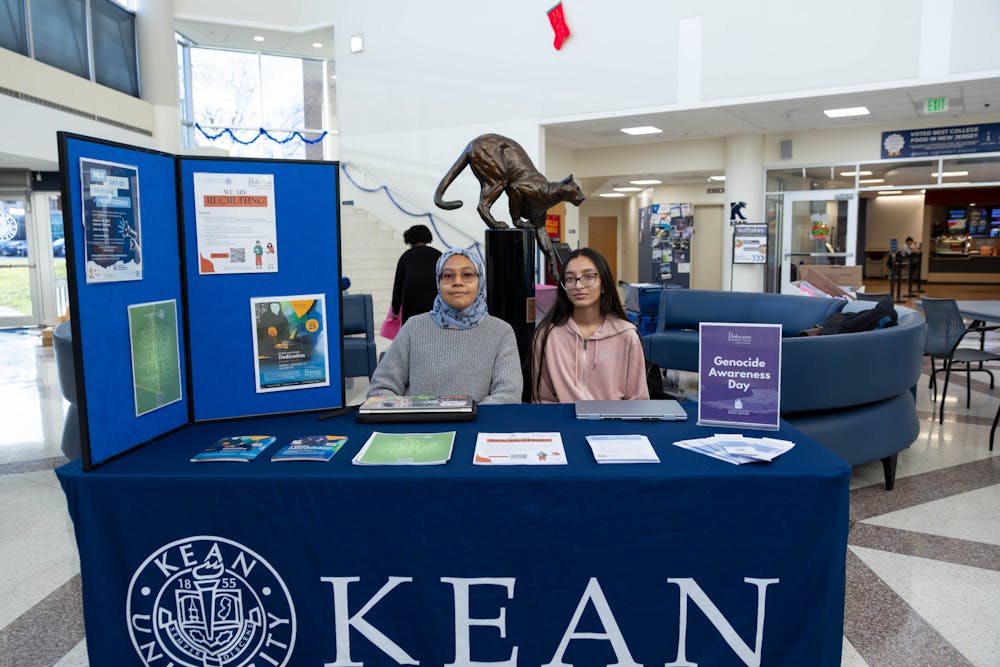
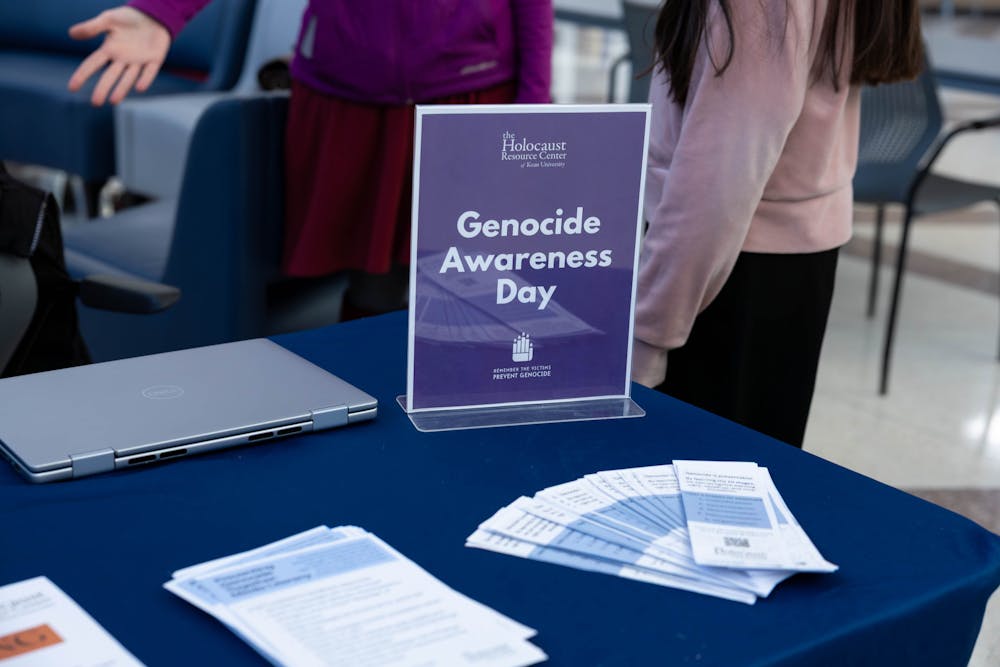
On Tuesday, December 9, Kean University’s Holocaust Resource Center and Human Rights Institute hosted a Genocide Prevention and Awareness Day tabling event, transforming the Miron Student Center Atrium into a space for reflection, learning, and community engagement. The event honored the International Day of Commemoration and Dignity of the Victims of the Crime of Genocide, observed annually on December 9, the same date the United Nations adopted the Genocide Convention in 1948.
Sarah Coykendall, Managing Assistant Director of the Holocaust Resource Center and Human Rights Institute, emphasized the Center’s origins and its continued purpose.
“Education plays into prevention because it allows people who may not understand that crimes against humanity, genocide, or other human rights violations are taking place… Everyone has an active voice in preventing and combating those injustices,” Coykendall stressed. “Prevention is key, and genocides don't have to happen. They're not inevitable, so we all have the power to stop them.”
From 2:30 to 4:30 p.m., students stopped by to explore educational materials, speak with staff and student workers, and learn about the historical and contemporary realities of genocide. The Holocaust Resource Center distributed media literacy packets, bookmarks outlining the ten stages of genocide, and informational pamphlets designed to help students recognize early warning signs of mass atrocity.
Student workers from the Holocaust Resource Center and Human Rights Institute shared their perspectives on why genocide education matters and how their peers can contribute to combating hate.
For Salma Abdallah, a Senior majoring in Cellular Molecular Biology, education, especially media literacy, is the foundation of prevention.
“The first tool against any kind of bigotry or any kind of discrimination really is education, but it doesn't necessarily have to be in a classroom,” Abdallah said. “You can learn about things like the Holocaust or the Armenian genocide literally by just looking it up online.”
But she cautioned that the abundance of online information requires careful evaluation.
“At first, you might not necessarily be able to tell what's a reliable source or not, which is why… we also have flyers on media literacy, and how to verify that a source is factual,” she said. “Look at whether the information is written to sensationalize, or is it written to inform?”
The Holocaust Resource Center is a result of a decades-long mission. Established in 1982 by a group of Holocaust survivors intent on creating a space for Holocaust education, the Center provides programming, events, and professional development for the Kean community.
Makkeedah Mitchell, a Senior and Criminal Justice major from East Orange, NJ, said the event expanded her understanding of genocide.
“I'm not too familiar with genocide, but just learning about it… there is a lot of things that I never knew,” she said. “It is informational.”
Mitchell believes students can make a difference through everyday actions.
“If you see something, say something,” she said. “Don’t be a bystander but help. Just bringing awareness helps… and you can help to spread that information within the community.”
Like Mitchell, other student workers said the event encouraged them to keep expanding their understanding and to engage more deeply with conversations about genocide.
Lauren Chirinos, a Junior majoring in Communication from Clifton, NJ, said working at the Human Rights Institute has deepened her conversations about genocide.
“I already knew a lot… but the pamphlet did teach me a lot,” she said. “I definitely have had more conversations with people about genocide while working here.”
She hopes students will take advantage of the information available to them.
“It is a little bit surprising when people don't know too much about genocide, just because of everything that's online,” she said. “If they were to look more at it, instead of scrolling past it and ignoring it, that would definitely help.”
The Genocide Prevention and Awareness Day event reflects the Holocaust Resource Center’s ongoing commitment to education, advocacy, and community engagement. By equipping students with historical knowledge, media literacy tools, and practical strategies for speaking up, the Center aims to empower the next generation to recognize and challenge injustice.