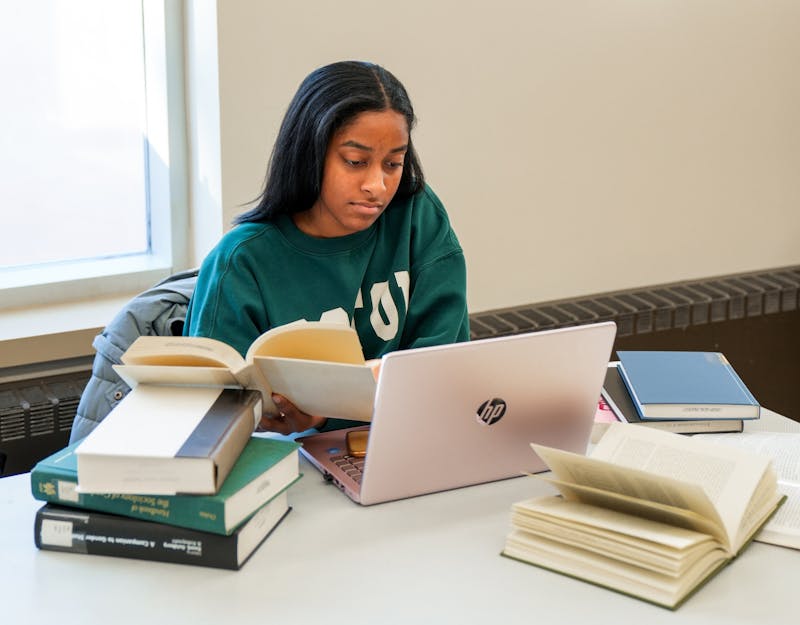
As a commuter school, most mornings at Kean don’t start in a dorm hallway. They start on highways, train platforms, and quiet neighborhood streets, long before the first class of the day. For thousands of students, the journey to campus is just as much a part of their college experience as anything that happens in the classroom.
Commuting can also feel wildly different for each student. Depending on the starting point, mode of transit, routine, expectations, and more, one individual’s journey can be entirely unique.
Take Kevin Modeszto, a Sophomore and Journalism major. His day starts in the early morning, as he must catch the train from Woodbridge Station to Newark Penn Station, where he then transfers to Union Station for his classes. On a good day, it’s an hour-long commute. On a bad day, it’s an hour and a half, and a whole lot of prayers that the transfer isn’t delayed.
“I’ve missed one class entirely because of trains running late,” he said. “There is no stress in my life like a train running indefinitely late and not knowing when I’ll get to where I need to go.”
Despite the chaos of NJ Transit, Kevin has built a full campus life. He’s heavily involved in The Tower, Kean’s student newspaper, spends most of his time in the Center for Academic Success, and has a tight-knit commuter friend group that formed during his first year.
“Especially in the first semester, none of us had really made friends, so we were all each other’s rocks,” he recalled. “Ninety percent of my social life first semester was with that group.”
For other students, commuting is short and sweet. Ahmir Ali Mansour, a Sophomore from Westfield, NJ, also takes the train, but for him the ride only lasts 20 minutes. “I’m usually early,” he said. “I just pick the train that best fits my schedule.”
Although trips are less stressful, Mansour still feels the gaps. “Having nowhere to rest is a downside,” he admitted. “Sometimes I wish I could lay down for a bit, especially if I’m gonna be on campus for an hour at a time between classes.”
Charlie Collins, a Freshman and Communication Studies major from Roselle, NJ, gets rides for her 10-minute driving commute.
“I like that I’m able to stay close with my family,” she said. But it’s the monotony of her home that can be detrimental to her studies. “As far as academic performance [and] stress management, it could get a little overwhelming... If I’m constantly studying at my desk in my bedroom, I would eventually want a different space after some time.”
Collins tries her best to keep up with campus events using Cougar Link and often utilizes the library for study sessions.
Another mode of commuting (and perhaps the most popular), driving can give students something the train never will: control. But it can also come with its own unpredictability.
Cristian Ferreira, a Junior and Political Science major from Newark, NJ, takes anywhere from 17 to 30 minutes to commute depending on traffic. “Commuting by car gives me more control,” he explained. “But, in my experience, it might also enable more procrastination, because sometimes we think we can beat the travel time and still arrive late.”
Summayya Kattaria, a Junior majoring in IT from Woodbridge, NJ, knows that struggle well. Her commute can be 20 minutes—or an hour—depending on traffic.
“I personally hate living far from campus,” she said. “It does get me stressed if I’ll end up being late to class.”
She’s on campus all day because of her early and late classes and on-campus job. Kattaria has also experienced commuting from the opposite end, as she used to live close enough to walk.
“It was a great struggle to walk in the freezing cold every day for about two years,” she remembered. “I would have to wear many layers of clothing and watch out for slippery ground.”
Despite the sometimes-chaotic nature of commuting, each student found a way of connecting to their campus. Modeszto spends much of his time outside of classes with the school newspaper. Mansour can while the hours away at the gym in Harwood Arena. Cristian likes to study in the Nancy Thompson Learning Commons. And Kattaria and Collins find community in the Muslim Student Association prayer room.
In place of the comfort of dorm lounges, bedrooms, and common areas, these spaces help commuters feel at home on campus, offering opportunities to nap, study, pray, eat, decompress, and wait out the gaps between classes.
Commuting can be stressful, and it’s sometimes a struggle to not let it shape your schedule. But it also builds valuable skills, like independence, resourcefulness, and adaptability. With thousands upon thousands of students sharing these same stories, the commuter experience is an integral part of Kean University.