
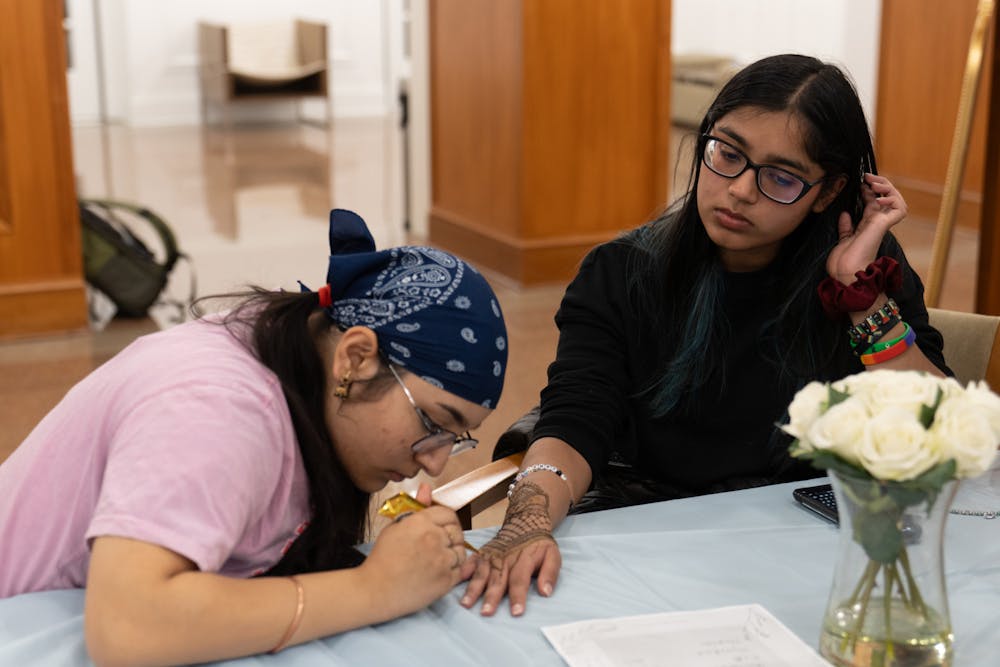
On Thursday, November 6, the Muslim Student Association hosted the semester’s very first Henna event.
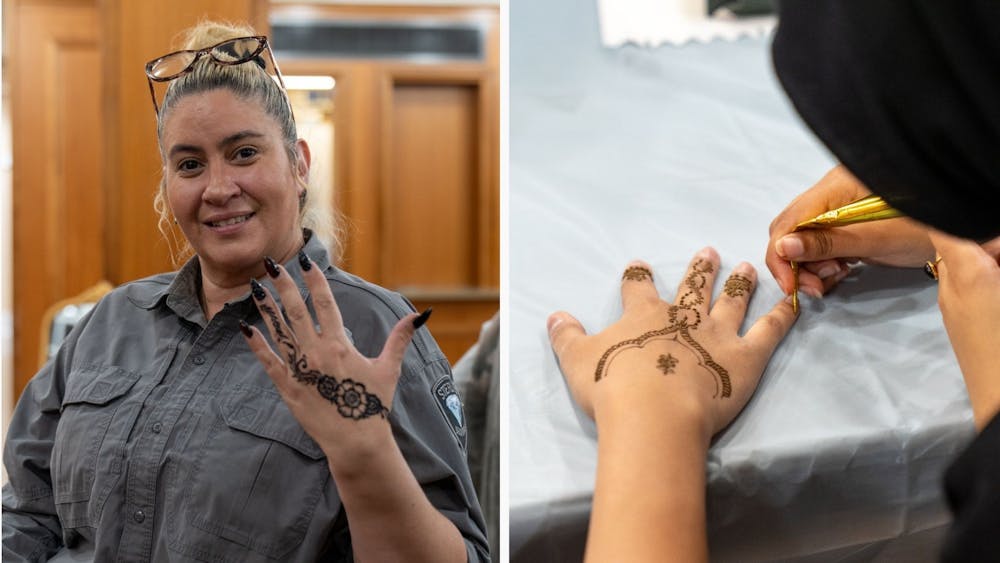
As the sun began to wane on Kean’s expansive East Campus, music filled the warmly lit lobby. Students entered the room decorated with standing mirrors and a large golden sign featuring details of the event in cursive lettering, to crowd the flower-strewn table where artists worked diligently on making richly dark patterns on customers’ hands.
Henna, also known as mehndi, is a dye traditionally made from mignonette trees. Used by both men and women, it is an ancient art form that temporarily tattoos the skin and colors the hair. For thousands of years, henna was an essential feature of celebrations such as marriage ceremonies and religious festivals. It remains prevalent in many Asian and African cultures today.
Hoda Soliman, the President of the Muslim Student Association and a Sophomore majoring in Speech Language Hearing Sciences from Millstone, NJ, explained the purpose of the event.
“We really wanted to do a fundraiser that was very interactive, something that people enjoy,” she said. “Especially since [previous ones were] such a hit and people have been requesting it.”
The Muslim Student Association is a religious and cultural organization for Muslim students and allies. It promotes knowledge of the religion of Islam and the diversity of its adherents. In addition to hosting educational programs and social activities, the club maintains a Muslim prayer room on the fourth floor of the Center for Academic Success.
Alaa Suleiman, the Vice President and a Senior majoring in Speech Language Pathology from Clifton, NJ, highlighted the recent Henna event for students. "We wanted to have a good time, showcase art and culture, and then also just raise some money for the MSA,” she said.
Kayanat Habib, a Freshman and Public Health major from Union, NJ, shared her reason for attending. “I was a part of the board of MSA in my high school, and I really want to enjoy that experience again during college,” she said. “So when [the MSA] had an event, I decided to come.”
Henna is a multicultural tradition and way of expression, found in various forms throughout Asia, Africa, and the Middle East. Along with painting intricate patterns along the hands, it is often used to dye the hair a vivid reddish-brown or orange.
For Sarah Singh, who is completing her first year of a Master’s in English Writing and is from Rahway, NJ, the event held special significance. “I’m fairly distant from my culture,” Sarah, who is Indian, admitted. “Getting stuff like this done reconnects me to it, and I feel closer to home.”
“[Events like these] really matter because you should share everybody's culture and learn inclusivity at these kinds of events,” Kayanat said.
Henna is not only cultural; for many, it can be a fun and low stakes pastime. Arielle Williams, a Freshman majoring in Business Marketing from Long Branch, NJ, got her henna done for that reason. “I mean, I just really enjoy henna and [doing] it on myself and my boyfriend,” she recalled. “So I figured, why not have someone just do it on me for a change?”
She showed off her design, an intricate skeleton pattern in a rich dark ink. Other patterns included geometric shapes and flower patterns.
“I think [doing henna] brings people together and invites them to try something new that they may or may not have tried already,” Arielle shared.
Sarah agreed. “[Events like this] have a lot of cultural significance and it connects people together that are from different backgrounds as well,” she said. “I don't know anything about Islam, but [I do] know what henna is, and I know these songs. I get to connect with these people that I would otherwise never speak to.”
The warm orange glow of the setting sun reflected the deep colors of the freshly painted designs on students’ hands as they filed out of East Campus at the event’s end. Art blended with history and culture in a beautiful display of campus unity.