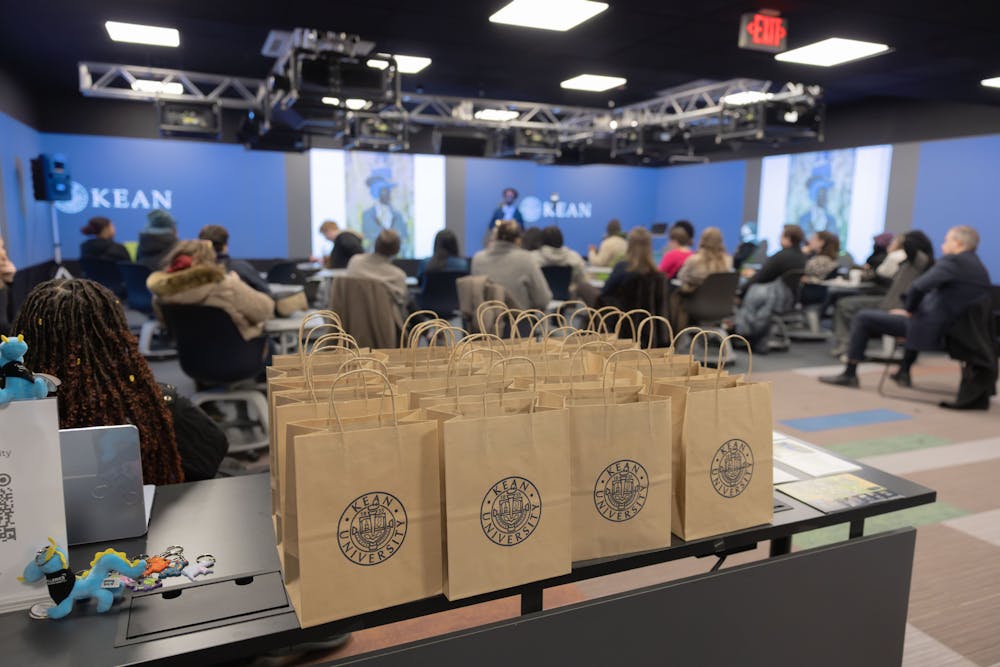
On Tuesday, February 3, 2026, The Galleries at Kean hosted Jaymes Jorsling to showcase “Hub City,” a multidisciplinary project highlighting America’s racial traumas, as part of its Transcending Boundaries art program. The Human Rights Institute and Holocaust Resource Center introduced Jorsling, a local artist, playwright and actor, to discuss his works and perspective on the power of art.
The exhibition centers on the history of Black struggles in New Brunswick, NJ, what Jorsling described as the midpoint between Philadelphia and New York City. Jorsling created Hub City to showcase the history of New Jersey, the last Northern state to abolish slavery and one of the most persistent in returning freed slaves to the South.
The theme for the event was bearing witness. As Jorsling put it, “bearing witness is to refuse numbness. Bearing witness is to look closely. It is to feel honestly. It is to do something in response to something.” To Jorsling, art has the ability to accomplish all of that, not just for the artist, but for the audience as well.
The artist then went on to discuss the main difference between photography and artwork: perception. “A photograph is reality, right? And in some ways, reality has limitations,” he said. “Art, you can add on, you can put layers... art has that power.”
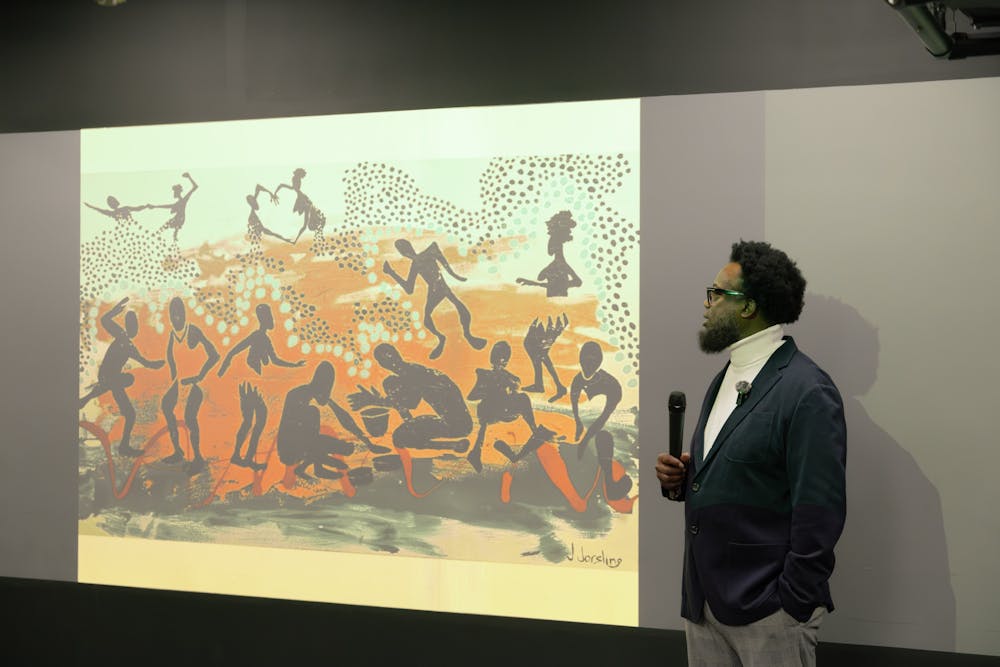
He walked the audience through some of his most notable works, a combination of acrylic and textiles. The first, depicting an African American woman dressed as a man, was inspired by the story of a runaway slave who broke into her master’s home and stole only his neckties. Jorsling decoded some of the symbols in the painting—the necktie, the stuffing in her jacket, her headwrap, and the textiles she held, even down to the aged parchment background—but he ultimately left it to the viewers to derive their own meaning from the work.
Another piece of the Hub City project featured, on one side, memory before captivity—an African village scene of community. On the other, it showed the captivity of those same Africans on American shores. In the middle was the Atlantic Ocean: a “beautiful graveyard,” as the artist described it, for how many Africans were killed during the Middle Passage. The painting, and others like it, was a testament to a forgotten history of Black people in New Jersey and throughout the United States.
It was a powerful depiction of duality: the before and after of the slave trade. All throughout the painting, however, was a sense of unity and strength. As Jorsling explained, “there's a lot of helping each other. People pulling each other up, people holding hands. It's like, how do you show unity? How do you show love? How do you show connectivity? [The] simple, beautiful thing is hand holding, hands reaching out, hands extending.”
At the end of the day, Jorsling left the audience with a powerful message: that art, with all its hidden meanings, is always up to the viewer’s interpretation. And it doesn’t stop at painting—music, filmmaking, and theater can all achieve the same purpose.
Jorsling's exhibition will be on display at the Human Rights Institute Gallery in the Nancy Thompson Learning Center from January 26th to March 27th. His Hub City is a quiet but powerful reminder of art’s ability to highlight the pain and beauty of the past. The stories it conveys will continue to highlight the history of Black people throughout America, well after Black History Month.